
𝐒𝐚𝐥𝐯𝐚𝐝𝐨𝐫 𝐃𝐚𝐥𝐢́'𝐬 "𝐁𝐨𝐨𝐤𝐬 𝐭𝐨 𝐁𝐢𝐫𝐝𝐬" (𝟏𝟗𝟑𝟏): 𝐀 𝐌𝐞𝐭𝐚𝐦𝐨𝐫𝐩𝐡𝐨𝐬𝐢𝐬 𝐨𝐟 𝐊𝐧𝐨𝐰𝐥𝐞𝐝𝐠𝐞 𝐢𝐧𝐭𝐨 𝐅𝐫𝐞𝐞𝐝𝐨𝐦

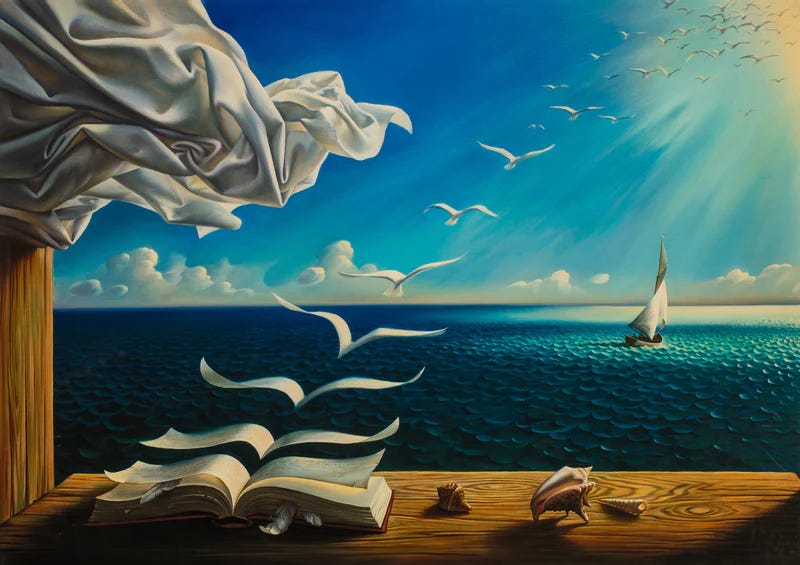
Rui Manuel de Almeida Pinheiro
━━━━━━━━━━━━━━━━━━━━━━━━━
𝐒𝐚𝐥𝐯𝐚𝐝𝐨𝐫 𝐃𝐚𝐥𝐢́’𝐬 “𝐁𝐨𝐨𝐤𝐬 𝐭𝐨 𝐁𝐢𝐫𝐝𝐬” (𝟏𝟗𝟑𝟏): 𝐀 𝐌𝐞𝐭𝐚𝐦𝐨𝐫𝐩𝐡𝐨𝐬𝐢𝐬 𝐨𝐟 𝐊𝐧𝐨𝐰𝐥𝐞𝐝𝐠𝐞 𝐢𝐧𝐭𝐨 𝐅𝐫𝐞𝐞𝐝𝐨𝐦
━━━━━━━━━━━━━━━━━━━━━━━━━
𝐇𝐢𝐬𝐭𝐨𝐫𝐢𝐜𝐚𝐥 𝐂𝐨𝐧𝐭𝐞𝐱𝐭 𝐚𝐧𝐝 𝐀𝐫𝐭𝐢𝐬𝐭𝐢𝐜 𝐌𝐨𝐦𝐞𝐧𝐭
The year 1931 stands as a pivotal moment in Salvador Dalí’s artistic trajectory, marking the crystallization of what would become his most significant contribution to Surrealism: the paranoiac-critical method. “Books to Birds” (also known as “Transformation of Books into a Bird” or “Libros transformándose en pássaros”) emerges from this crucial period, representing a concise yet profound exploration of metamorphosis that would define Dalí’s mature work.
In 1931, Dalí was twenty-seven years old and fully immersed in the Parisian Surrealist circle. This was the same year he painted his most iconic work, “The Persistence of Memory,” with its melting clocks that challenged conventional notions of time and reality. However, while “The Persistence of Memory” has garnered widespread recognition, “Books to Birds” offers an equally compelling yet more intimate meditation on transformation, knowledge, and liberation.
This period marked Dalí’s systematic development of the paranoiac-critical method, a surrealist technique he described as a “spontaneous method of irrational knowledge based on the critical and systematic objectification of delirious associations and interpretations.” Unlike the automatic writing and drawing favored by other Surrealists, Dalí’s approach was deliberate and controlled, requiring the artist to cultivate a state of paranoid thinking while maintaining critical awareness. “Books to Birds” exemplifies this method, presenting a rational impossibility—the transformation of inanimate object into living creature—with such convincing detail that it momentarily suspends the viewer’s disbelief.
𝐏𝐡𝐲𝐬𝐢𝐜𝐚𝐥 𝐂𝐡𝐚𝐫𝐚𝐜𝐭𝐞𝐫𝐢𝐬𝐭𝐢𝐜𝐬 𝐚𝐧𝐝 𝐓𝐞𝐜𝐡𝐧𝐢𝐪𝐮𝐞
“Books to Birds” is executed in oil on wooden panel, measuring approximately 12.7 × 17.8 cm—a diminutive format that demands intimate engagement from the viewer. This small scale is significant; it transforms the act of viewing into something akin to peering into a private vision or examining a precious artifact. The reduced dimensions force a concentrated observation, inviting the viewer into what Dalí himself might have called a “microcosm of hallucination.”
Dalí’s technique in this work demonstrates the miniaturist precision that would become his hallmark. He employs brushstrokes so fine that they effectively disguise the materiality of paint itself, creating an illusion of tactile reality that borders on the photographic. This hyperrealistic approach serves a crucial surrealist function: by rendering the impossible with such meticulous realism, Dalí destabilizes the viewer’s confidence in distinguishing between the real and the imagined.
The palette consists primarily of ochres, beiges, and blue-grays, creating an atmosphere of serene wonder rather than dramatic upheaval. The subdued color scheme enhances the sense of quiet miracle, suggesting that this transformation is not a violent rupture but a natural unfolding of hidden potential. The soft, diffused lighting bathes the scene in an almost sacred glow, elevating the metamorphosis from mere visual trick to something approaching spiritual revelation.
𝐈𝐜𝐨𝐧𝐨𝐠𝐫𝐚𝐩𝐡𝐢𝐜 𝐀𝐧𝐚𝐥𝐲𝐬𝐢𝐬: 𝐓𝐡𝐞 𝐁𝐨𝐨𝐤 𝐚𝐬 𝐑𝐚𝐭𝐢𝐨𝐧𝐚𝐥 𝐒𝐭𝐫𝐮𝐜𝐭𝐮𝐫𝐞
The book, as depicted in “Books to Birds,” carries profound symbolic weight in Dalí’s iconography. Throughout his career, books represented ordered knowledge, rational thought, and the accumulated wisdom of civilization. They are structures of containment—both physically, as objects with covers and pages, and metaphorically, as vessels of human understanding bound by logic and linear narrative.
In the context of 1931, the book held additional significance. Dalí was deeply engaged with literary and philosophical texts, from Freud’s psychoanalytic theories to the writings of the Marquis de Sade and Lautréamont. The book represented the intellectual framework that Dalí simultaneously revered and sought to transcend. By depicting books in a state of transformation, Dalí suggests that rigid structures of knowledge must dissolve to access deeper, more intuitive forms of understanding.
The specific treatment of the books in this work is telling. They do not simply sit as static objects; they are caught in a moment of becoming. The pages unfold and lift, no longer bound by the constraints of the cover or the sequence of numbered pages. This liberation of the page from the book mirrors the Surrealist desire to free thought from the constraints of rational discourse and logical progression.
𝐓𝐡𝐞 𝐁𝐢𝐫𝐝: 𝐒𝐲𝐦𝐛𝐨𝐥 𝐨𝐟 𝐔𝐧𝐜𝐨𝐧𝐬𝐜𝐢𝐨𝐮𝐬 𝐃𝐞𝐬𝐢𝐫𝐞
If the book represents the rational and the structured, the bird embodies its opposite: freedom, intuition, and the unbounded movements of the unconscious mind. In Dalí’s symbolic vocabulary, birds frequently appear as messengers between different realms of existence, creatures capable of traversing the boundary between earth and sky, conscious and unconscious, material and spiritual.
The transformation of book pages into wings is particularly significant. Wings suggest flight, elevation, and transcendence—qualities that stand in direct opposition to the weight and solidity of the book. Where the book is grounded, the bird is airborne; where the book contains, the bird escapes; where the book preserves the past, the bird inhabits the present moment of flight.
This metamorphosis also carries erotic undertones, consistent with Dalí’s Freudian influences. The bird, with its associations of lightness and upward movement, can be read as a symbol of libidinal energy breaking free from repression. The transformation suggests that knowledge itself, when truly understood, becomes animate and desires expression beyond the confines of textual representation.
𝐓𝐡𝐞 𝐌𝐞𝐭𝐚𝐦𝐨𝐫𝐩𝐡𝐨𝐬𝐢𝐬: 𝐏𝐫𝐨𝐜𝐞𝐬𝐬 𝐚𝐧𝐝 𝐏𝐡𝐢𝐥𝐨𝐬𝐨𝐩𝐡𝐲
What makes “Books to Birds” particularly remarkable is not merely the presence of both books and birds, but the depiction of the transformation itself. Dalí does not show a book next to a bird, nor does he present a simple substitution. Instead, he captures the precise moment of metamorphosis, where the boundaries between categories dissolve and one state of being flows seamlessly into another.
This focus on process rather than product reflects Dalí’s engagement with alchemical thinking. The alchemists sought to transform base metals into gold, not merely as a material process but as a spiritual one—a transformation of the self through the transformation of matter. Similarly, Dalí’s visual alchemy transforms the base materiality of the book into the golden freedom of the bird, suggesting that knowledge, when properly understood, undergoes a transmutation that liberates it from its physical form.
The transformation is depicted as fluid and natural, devoid of violence or struggle. This is crucial to understanding Dalí’s philosophical position. He is not advocating for the destruction of knowledge or rational thought, but rather for their evolution into something more alive, more responsive, more free. The book does not die to become a bird; it reveals its true nature, which was always potentially avian.
𝐓𝐡𝐞 𝐂𝐨𝐦𝐩𝐨𝐬𝐢𝐭𝐢𝐨𝐧𝐚𝐥 𝐄𝐥𝐞𝐦𝐞𝐧𝐭𝐬: 𝐒𝐞𝐚, 𝐒𝐤𝐲, 𝐚𝐧𝐝 𝐇𝐨𝐫𝐢𝐳𝐨𝐧
The setting of “Books to Birds” enhances its thematic concerns. The wooden surface on which the books rest suggests a table or desk—a place of study and intellectual labor. Yet this surface opens onto a seascape, with water stretching to the horizon and a sailboat visible in the distance. The sea, in Surrealist iconography, often represents the unconscious mind, vast and unfathomable, hiding depths beneath its surface.
Above, the sky is populated with birds in various stages of flight, creating a visual echo of the transformation occurring on the table. The presence of the sailboat is significant: like the birds, it is a vehicle of movement and journey, but it travels on the sea rather than in the air, suggesting different modes of traversing the unknown.
The horizon line, where sea meets sky, represents a boundary that is simultaneously real and illusory—a visual manifestation of the liminal space that Dalí’s work inhabits. It is the threshold between conscious and unconscious, rational and irrational, material and spiritual. The transformation of books into birds occurs at this threshold, suggesting that such metamorphosis is only possible when one occupies this in-between space.
𝐓𝐡𝐞 𝐏𝐚𝐫𝐚𝐧𝐨𝐢𝐚𝐜-𝐂𝐫𝐢𝐭𝐢𝐜𝐚𝐥 𝐌𝐞𝐭𝐡𝐨𝐝 𝐢𝐧 𝐏𝐫𝐚𝐜𝐭𝐢𝐜𝐞
“Books to Birds” serves as an exemplary demonstration of Dalí’s paranoiac-critical method. The work invites multiple, simultaneous interpretations without privileging any single reading. Is this a meditation on the limitations of textual knowledge? A visualization of creative inspiration? An erotic allegory? A spiritual statement about the soul’s liberation?
The paranoiac-critical method requires the viewer to cultivate a state of “delirious association,” allowing the mind to make connections that rational thought would reject. In this state, the transformation of book into bird becomes not just plausible but inevitable. The viewer begins to see that books have always been potential birds, that knowledge has always desired flight, that the page has always yearned to become a wing.
This method also operates through what Dalí called “simulacra”—the ability to see one thing as another. In “Books to Birds,” the simulacrum is built into the composition itself. The pages are simultaneously pages and wings; the book is simultaneously book and bird. This double vision is the essence of the paranoiac-critical method, and Dalí renders it with such precision that the viewer experiences the cognitive dissonance of holding two contradictory truths simultaneously.
𝐑𝐞𝐥𝐚𝐭𝐢𝐨𝐧𝐬𝐡𝐢𝐩 𝐭𝐨 𝐃𝐚𝐥𝐢́’𝐬 𝐁𝐫𝐨𝐚𝐝𝐞𝐫 𝐎𝐞𝐮𝐯𝐫𝐞
Within Dalí’s body of work, “Books to Birds” occupies an important position as a concise statement of themes that would occupy him throughout his career. The interest in metamorphosis evident here would later manifest in works like “Metamorphosis of Narcissus” (1937), where the figure of Narcissus transforms into an egg and a flower. The concern with the dissolution of solid forms prefigures the melting clocks of “The Persistence of Memory” and the disintegrating objects of his later “nuclear mysticism” period.
The small format of “Books to Birds” also connects it to a tradition of intimate, jewel-like works that Dalí produced alongside his larger, more spectacular canvases. These smaller works often possess a concentration of meaning and a precision of execution that their larger counterparts sometimes lack. They function as visual haikus, achieving maximum effect through economy of means.
The work also anticipates Dalí’s lifelong fascination with the relationship between art and science, between the visible and the invisible. The transformation depicted in “Books to Birds” can be read as a visualization of energy converting from one form to another, a theme that would become central to Dalí’s work after his encounter with quantum physics and nuclear theory in the 1940s and 1950s.
𝐂𝐮𝐥𝐭𝐮𝐫𝐚𝐥 𝐚𝐧𝐝 𝐏𝐡𝐢𝐥𝐨𝐬𝐨𝐩𝐡𝐢𝐜𝐚𝐥 𝐈𝐦𝐩𝐥𝐢𝐜𝐚𝐭𝐢𝐨𝐧𝐬
Beyond its place in Dalí’s personal artistic development, “Books to Birds” engages with broader cultural and philosophical questions that remain relevant today. In an age of information overload, where knowledge is increasingly digitized and dematerialized, the transformation of the physical book into something more ethereal takes on new resonance. Dalí’s vision of books becoming birds can be read as a prophecy of the digital age, where text detaches itself from the page and flies through the virtual ether.
The work also speaks to the tension between tradition and innovation, between the preservation of knowledge and its transformation. Dalí does not reject the book; he reveals its hidden potential. This suggests that true innovation does not require the destruction of the past but rather its metamorphosis into new forms. The wisdom of the past can take flight, carrying its essential truth into new contexts and new meanings.
Furthermore, “Books to Birds” addresses the relationship between knowledge and freedom. The book, as a symbol of accumulated wisdom, can also represent constraint—the weight of tradition, the authority of the text, the limitation of fixed meaning. The bird represents liberation from these constraints, but crucially, it is not a liberation that abandons knowledge. Rather, it is knowledge itself that achieves freedom, suggesting that true understanding is inherently liberating.
𝐂𝐨𝐧𝐜𝐥𝐮𝐬𝐢𝐨𝐧: 𝐓𝐡𝐞 𝐄𝐧𝐝𝐮𝐫𝐢𝐧𝐠 𝐏𝐨𝐰𝐞𝐫 𝐨𝐟 𝐕𝐢𝐬𝐮𝐚𝐥 𝐏𝐨𝐞𝐭𝐫𝐲
“Books to Birds” remains one of Dalí’s most poetically concise works, achieving in its small format what larger canvases sometimes struggle to accomplish: a perfect fusion of concept and execution, meaning and form. The work demonstrates that Surrealism at its best is not merely about shock or surprise, but about revealing hidden connections that, once seen, appear inevitable.
Nearly a century after its creation, “Books to Birds” continues to resonate because it addresses fundamental human concerns: the nature of knowledge, the desire for freedom, the possibility of transformation. It suggests that the rigid structures we build—whether of thought, of society, or of art—contain within themselves the potential for their own transcendence. The book wants to become a bird; knowledge desires to take flight; the rational longs to merge with the mystical.
In the end, “Books to Birds” is not just a painting about books and birds. It is a meditation on the nature of reality itself, suggesting that what we perceive as fixed and solid is merely a temporary state, always on the verge of becoming something else. Dalí’s genius lies in capturing that moment of becoming, freezing it in paint so that we might contemplate the infinite possibilities hidden within the seemingly ordinary objects of our world.
The work invites us to look at our own books, our own structures of knowledge, and wonder: what birds are waiting to emerge? What transformations are poised to occur? In asking these questions, “Books to Birds” fulfills the highest purpose of Surrealist art: to awaken us to the marvelous hidden within the mundane, to reveal the extraordinary possibilities that lie dormant in the ordinary world.